
SAS (Collector method) - v1.0.0
About Collectors
Collectors are extractors that are developed and managed by you (A customer of K).
KADA provides python libraries that customers can use to quickly deploy a Collector.
Why you should use a Collector
There are several reasons why you may use a collector vs the direct connect extractor:
You are using the KADA SaaS offering and it cannot connect to your sources due to firewall restrictions
You want to push metadata to KADA rather than allow it pull data for Security reasons
You want to inspect the metadata before pushing it to K
Using a collector requires you to manage
Deploying and orchestrating the extract code
Managing a high water mark so the extract only pull the latest metadata
Storing and pushing the extracts to your K instance.
Pre-requisites
Collector Server Minimum Requirements
For the collector to operate effectively, it will need to be deployed on a server with the below minimum specifications:
CPU: 2 vCPU
Memory: 8GB
Storage: 30GB (depends on historical data extracted)
OS: unix distro e.g. RHEL preferred but can also work with Windows Server.
Python 3.10.x or later
Access to K landing directory
SAS Requirements
SAS Project Logs
In SAS Studio/Enterprise Guide
If using SAS GUI (Studio/Enterprise Guide), KADA utilises the Project Logs from your SAS process flows. If logs have not been enabled - follow the Official SAS Documentation to enable Project Logs.
The log window appears automatically alongside your code and results. You can:
Click the "Log" tab to view the full log
Right-click in the log window and select "Save As" to export
In Base SAS
The log window is visible by default in the main interface
Use
File > Save Asto save the logOr use
PROC PRINTTOto redirect logs to a file - PROC PRINTTO

Depending on your configuration settings, SAS Logs can contain structured logging prefixes for each line. KADA currently supports with the format below and without any prefix.
2024-02-03T14:30:15,456 INFO [12345678] :jdoe_username SAS Log Begin
Please make note of this status to fill in config setting pid_logs below.
SAS Viya is not currently supported
Step 1: Create the Source in K
Create a SAS source in K
Go to Settings, Select Sources and click Add Source
Select SAS as the Source Type
Select “Load from File” option
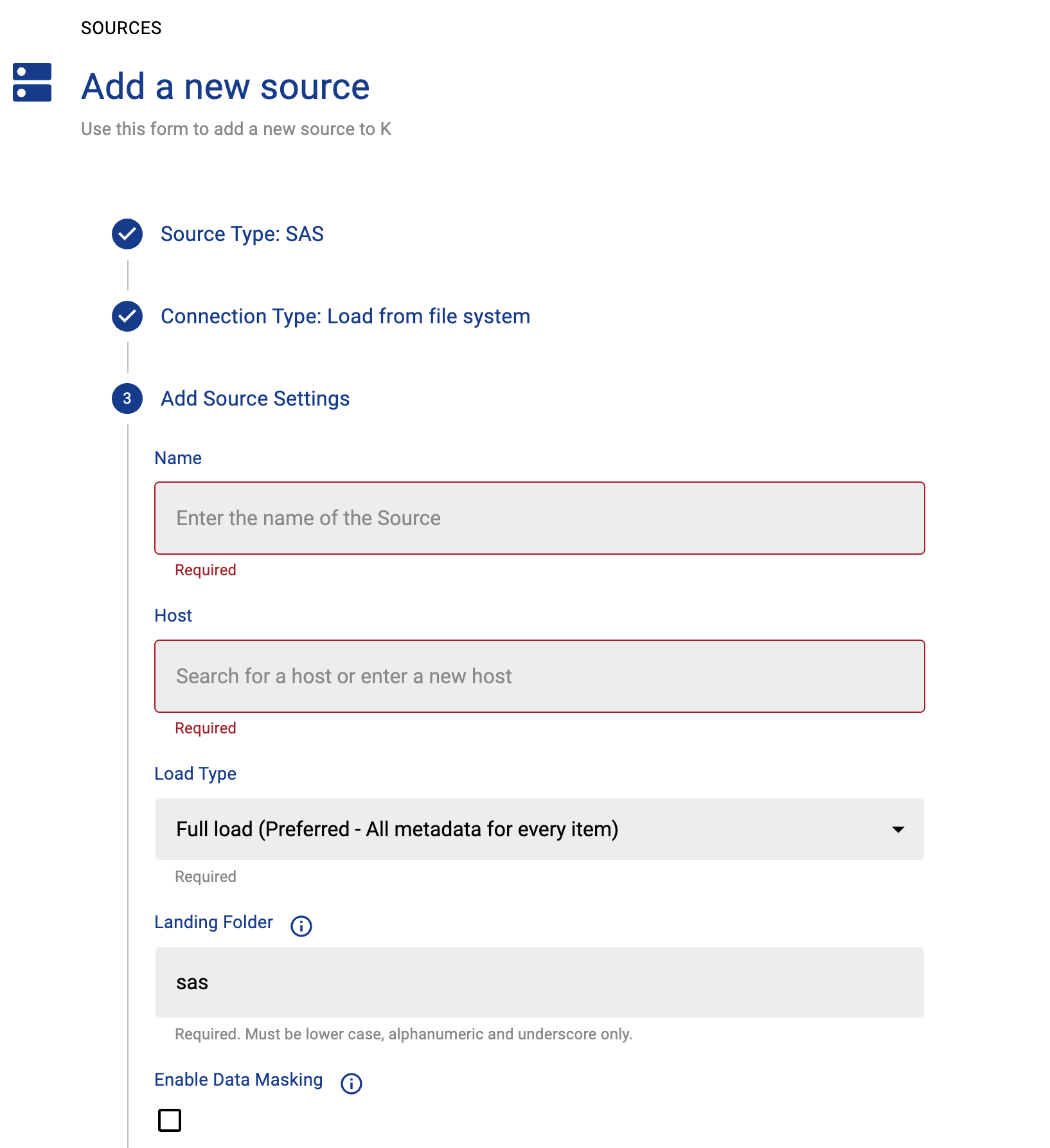
Give the source a Name - e.g. SAS Production
Add the Host name for the SAS instance
Click Finish Setup
Step 2: Getting Access to the Source Landing Directory
When using a Collector you will push metadata to a K landing directory.
To find your landing directory you will need to
Go to Platform Settings - Settings. Note down the value of this setting
If using Azure: storage_azure_storage_account
if using AWS:
storage_root_folder - the AWS s3 bucket
storage_aws_region - the region where the AWS s3 bucket is hosted
Go to Sources - Edit the Source you have configured. Note down the landing directory in the About this Source section
To connect to the landing directory you will need
If using Azure: a SAS token to push data to the landing directory. Request this from KADA Support (support@kada.ai)
if using AWS:
an Access key and Secret. Request this from KADA Support (support@kada.ai)
OR provide your IAM role to KADA Support to provision access.
Step 3: Install the Collector
It is recommended to use a python environment such as pyenv or pipenv if you are not intending to install this package at the system level.
Some python packages also have dependencies on the OS level packages, so you may be required to install additional OS packages if the below fails to install.
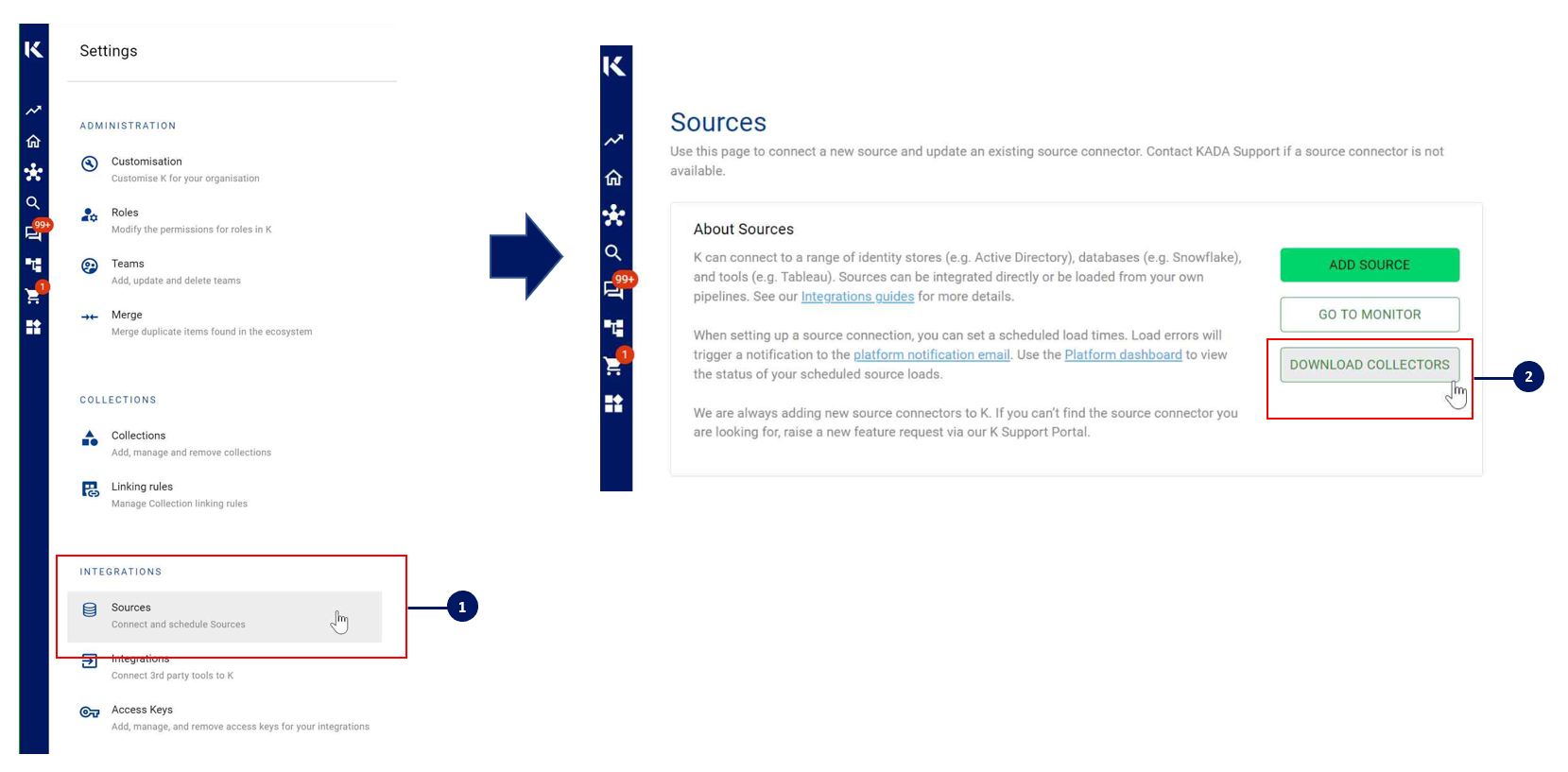
You can download the latest Core Library and whl via Platform Settings → Sources → Download Collectors
Run the following command to install the collector
pip install kada_collectors_extractors_<version>-none-any.whlYou will also need to install the common library kada_collectors_lib for this collector to function properly.
pip install kada_collectors_lib-<version>-none-any.whlStep 4: Configure the Collector
The collector requires a set of parameters to connect to and extract metadata from Tableau.
FIELD | FIELD TYPE | DESCRIPTION | EXAMPLE |
|---|---|---|---|
pid_logs | boolean | Indicates whether logs provided have pid structured logging enabled. ie. | true |
input_path | string | Absolute path to the input folder where the SAS logs have been extracted to. | “/tmp/input” |
output_path | string | Absolute path to the output location where files are to be written | “tmp/output” |
mask | boolean | To enable masking or not | true |
compress | boolean | To gzip the output or not | true |
dry_run | boolean | By doing a dry run you produce the mapping.json file which is used to populate the mapping field below. It is recommended you do a dry run first to see what databases are available to map. | true |
mapping | JSON | Mapping file of data source names against the onboarded host and database name in K | Assuming I have a “myDSN” data source name in powerbi, I’ll map it to host “myhost” and database “mydatabase” onboarded in K, snowflake type references are handled automatically
CODE
|
These parameters can be added directly into the run or you can use pass the parameters in via a JSON file. The following is an example you can use that is included in the example run code below.
kada_sas_extractor.json
{
    "output_path": "",
    "folder_path": "",
    "dry_run": false,
    "compress": false,
    "mask": false,
    "pid_logs": false.
    "mappin": {}
}
Step 7: Run the Collector
The following code is an example of how to run the extractor. You may need to uplift this code to meet any code standards at your organisation.
This can be executed in any python environment where the whl has been installed.
This is the wrapper script: kada_sas_extractor.py
import os
import argparse
from kada_collectors.extractors.utils import load_config, get_hwm, publish_hwm, get_generic_logger
from kada_collectors.extractors.sas import Extractor

get_generic_logger('root') # Set to use the root logger, you can change the context accordingly or define your own logger

_type = 'sas'
dirname = os.path.dirname(__file__)
filename = os.path.join(dirname, 'kada_{}_extractor_config.json'.format(_type))

parser = argparse.ArgumentParser(description='KADA SAS Extractor.')
parser.add_argument('--config', '-c', dest='config', default=filename, help='Location of the configuration json, default is the config json in the same directory as the script.')
parser.add_argument('--name', '-n', dest='name', default=_type, help='Name of the collector instance.')
args = parser.parse_args()

start_hwm, end_hwm = get_hwm(args.name)

ext = Extractor(**load_config(args.config))

ext.run(**{"start_hwm": start_hwm, "end_hwm": end_hwm})

publish_hwm(args.name, end_hwm)
Step 8: Check the Collector Outputs
K Extracts
A set of files (eg metadata, linkages, events etc) will be generated. These files will appear in the output_path directory you set in the configuration details
High Water Mark File
A high water mark file is created in the same directory as the execution called sas_hwm.txt and produce files according to the configuration JSON. This file is only produced if you call the publish_hwm method.
Step 9: Push the Extracts to K
Once the files have been validated, you can push the files to the K landing directory..
You can use Azure Storage Explorer if you want to initially do this manually. You can push the files using python as well (see Airflow example below)
Example: Using Airflow to orchestrate the Extract and Push to K
# built-in
import os

# Installed
from airflow.operators.python_operator import PythonOperator
from airflow.models.dag import DAG
from airflow.operators.dummy import DummyOperator
from airflow.utils.dates import days_ago
from airflow.utils.task_group import TaskGroup

from plugins.utils.azure_blob_storage import AzureBlobStorage

from kada_collectors.extractors.utils import load_config, get_hwm, publish_hwm, get_generic_logger
from kada_collectors.extractors.tableau import Extractor

# To be configed by the customer.
# Note variables may change if using a different object store.
KADA_SAS_TOKEN = os.getenv("KADA_SAS_TOKEN")
KADA_CONTAINER = ""
KADA_STORAGE_ACCOUNT = ""
KADA_LANDING_PATH = "lz/tableau/landing"
KADA_EXTRACTOR_CONFIG = {
    "server_address": "http://tabserver",
    "username": "user",
    "password": "password",
    "sites": [],
    "db_host": "tabserver",
    "db_username": "repo_user",
    "db_password": "repo_password",
    "db_port": 8060,
    "db_name": "workgroup",
    "meta_only": False,
    "retries": 5,
    "dry_run": False,
    "output_path": "/set/to/output/path",
    "mask": True,
    "mapping": {}
}

# To be implemented by the customer.
# Upload to your landing zone storage.
def upload():
  output = KADA_EXTRACTOR_CONFIG['output_path']
  for filename in os.listdir(output):
      if filename.endswith('.csv'):
        file_to_upload_path = os.path.join(output, filename)

        AzureBlobStorage.upload_file_sas_token(
            client=KADA_SAS_TOKEN,
            storage_account=KADA_STORAGE_ACCOUNT,
            container=KADA_CONTAINER,
            blob=f'{KADA_LANDING_PATH}/{filename}',
            local_path=file_to_upload_path
        )

with DAG(dag_id="taskgroup_example", start_date=days_ago(1)) as dag:

    # To be implemented by the customer.
    # Retrieve the timestamp from the prior run
    start_hwm = 'YYYY-MM-DD HH:mm:SS'
    end_hwm = 'YYYY-MM-DD HH:mm:SS' # timestamp now

    ext = Extractor(**KADA_EXTRACTOR_CONFIG)

    start = DummyOperator(task_id="start")

    with TaskGroup("taskgroup_1", tooltip="extract tableau and upload") as extract_upload:
        task_1 = PythonOperator(
            task_id="extract_tableau",
            python_callable=ext.run,
            op_kwargs={"start_hwm": start_hwm, "end_hwm": end_hwm},
            provide_context=True,
        )

        task_2 = PythonOperator(
            task_id="upload_extracts",
            python_callable=upload,
            op_kwargs={},
            provide_context=True,
        )

        # To be implemented by the customer.
        # Timestamp needs to be saved for next run
        task_3 = DummyOperator(task_id='save_hwm')

    end = DummyOperator(task_id='end')

    start >> extract_upload >> end