
Updated in Version 6.0
This page provides an overview of K's architecture, including its core services, interfaces, data stores, and inputs.
Overview of K Architecture
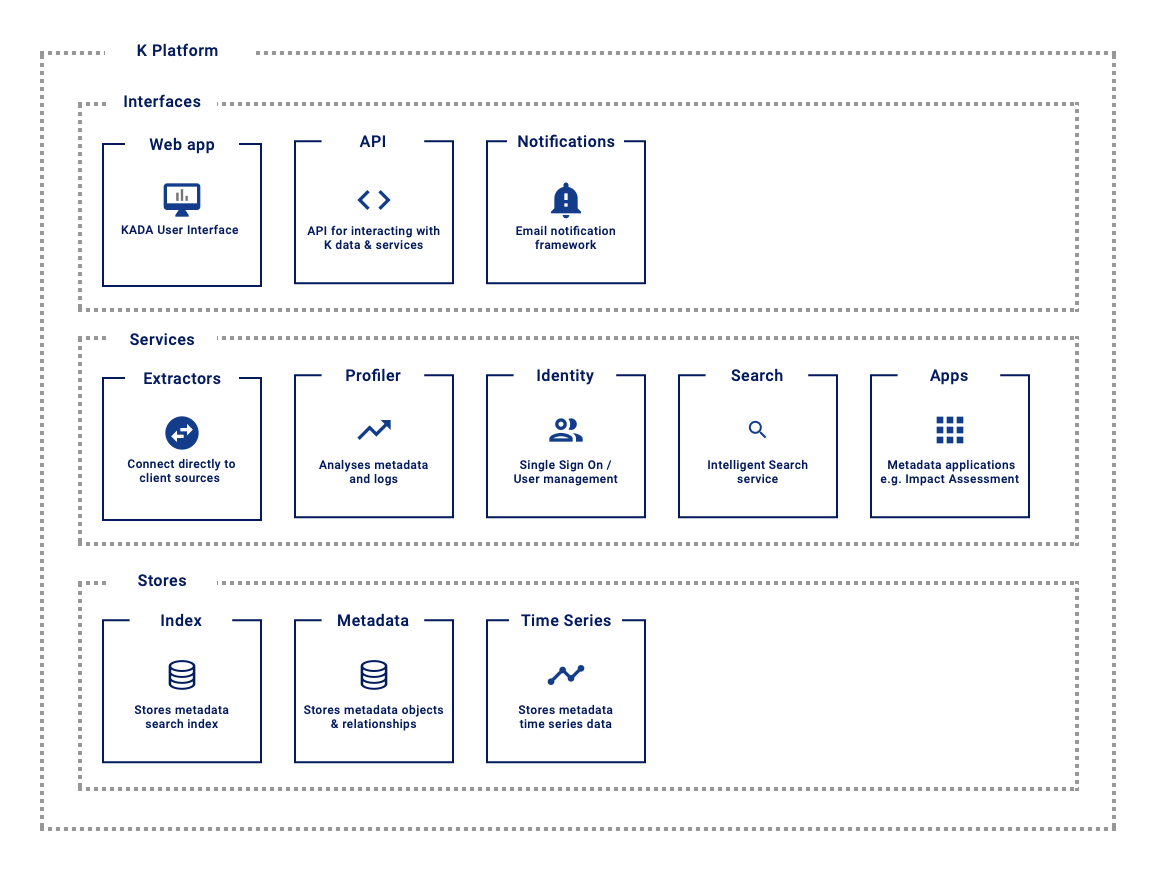
K Services
|
Component |
Description |
|---|---|
|
Extractors |
Connects to, extracts, and loads metadata and usage logs from data sources and tools. Can also be deployed as a collector service for on-premise sources when direct access to the K SaaS offering is not available. |
|
Profiler |
Identifies and profiles data assets and their usage. Proprietary algorithms automatically match and analyse data assets across their lifecycle. |
|
Identity |
Integrates with the Enterprise Identity Management service to provide single sign-on. |
|
Search |
Provides fast, accurate and contextual search across all assets within K. |
|
Applications |
Powers dedicated applications built to solve specific data problems (e.g. migration assessment, impact assessment). |
Interfaces
|
Component |
Description |
|---|---|
|
API |
Used by applications and services to interact with and access data managed by K. |
|
Web Portal |
Used by end users (e.g. data managers, analysts) to access K and its services. |
|
Notifications |
Engages with end users via push notifications (e.g. email alerts). |
Stores
|
Component |
Description |
|---|---|
|
Metadata |
Stores details and relationships between data assets, reports, users, teams and other objects in the data ecosystem. |
|
Timeseries |
Stores each data asset, person, or content item and its lifecycle over time. |
|
Index |
Each object in the data ecosystem is added to a search index to power the contextual search service. |
Inputs
|
Component |
Description |
|---|---|
|
Data Sources |
Databases (e.g. Teradata, Hadoop, Snowflake, SQL Server) where data is stored and used by enterprise data teams. K has integrators for many on-premise and cloud data sources, and can ingest custom sources through the K ingestion framework. |
|
Data Tools |
Reporting and analytics applications (e.g. Tableau, Power BI) used by enterprise data teams. K has integrators for common data tools and can ingest custom tools through the K ingestion framework. |
|
Identity |
Identity providers and user management sources (e.g. LDAP, SAML, OpenID Connect) for single sign-on and user/team data. |