
About Collectors
Collectors are extractors that are developed and managed by you (a customer of K).
KADA provides python libraries that customers can use to quickly deploy a Collector.
Why you should use a Collector
There are several reasons why you may use a collector vs the direct connect extractor:
-
You are using the KADA SaaS offering and it cannot connect to your sources due to firewall restrictions
-
You want to push metadata to KADA rather than allow it to pull data for security reasons
-
You want to inspect the metadata before pushing it to K
Using a collector requires you to manage:
-
Deploying and orchestrating the extract code
-
Managing a high water mark so the extract only pulls the latest metadata
-
Storing and pushing the extracts to your K instance
Downloading the latest Collector and Core Library
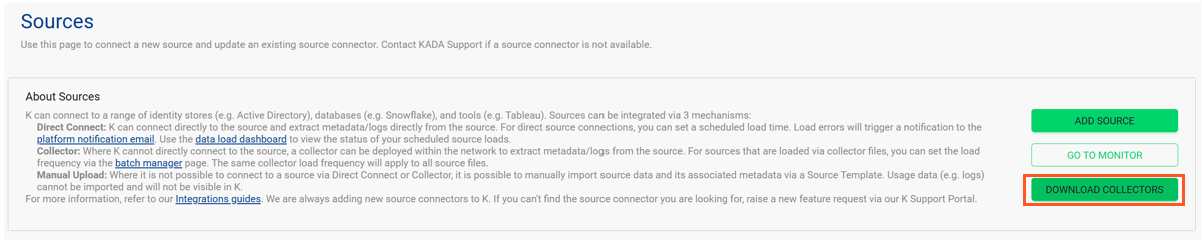
The latest core library needs to be installed prior to deploying a Collector. You can download the latest Core Library and Collector whl via Platform Settings → Sources → Download Collectors.
Collector Server Minimum Specifications
For the collector to operate effectively, it will need to be deployed on a server with the below minimum specifications:
-
CPU: 2 vCPU
-
Memory: 8GB
-
Storage: 30GB (depends on historical data extracted)
-
OS: unix distro e.g. RHEL preferred but can also work with Windows Server
-
Python 3.10.x or later
-
Access to K landing directory
About Landing Directories
When using a Collector you will push metadata to a K landing directory.
To find your landing directory you will need to:
-
Go to Platform Settings - Settings. Note down the value of this setting:
-
If using Azure: storage_azure_storage_account
-
If using AWS:
-
storage_root_folder - the AWS s3 bucket
-
storage_aws_region - the region where the AWS s3 bucket is hosted
-
-
-
Go to Sources - Edit the Source you have configured. Note down the landing directory in the About this Source section.
To connect to the landing directory you will need:
-
If using Azure: a SAS token to push data to the landing directory. Request this from KADA Support (support@kada.ai)
-
If using AWS:
-
An Access key and Secret. Request this from KADA Support (support@kada.ai)
-
OR provide your IAM role to KADA Support to provision access.
-
Airflow Example
The following example is how you can orchestrate the Tableau collector using Airflow and push the files to K hosted on Azure. The code is not expected to be used as-is but as a template for your own DAG.
# built-in
import os

# Installed
from airflow.operators.python_operator import PythonOperator
from airflow.models.dag import DAG
from airflow.operators.dummy import DummyOperator
from airflow.utils.dates import days_ago
from airflow.utils.task_group import TaskGroup

from plugins.utils.azure_blob_storage import AzureBlobStorage

from kada_collectors.extractors.utils import load_config, get_hwm, publish_hwm, get_generic_logger
from kada_collectors.extractors.tableau import Extractor

# To be configured by the customer.
# Note variables may change if using a different object store.
KADA_SAS_TOKEN = os.getenv("KADA_SAS_TOKEN")
KADA_CONTAINER = ""
KADA_STORAGE_ACCOUNT = ""
KADA_LANDING_PATH = "lz/tableau/landing"
KADA_EXTRACTOR_CONFIG = {
    "server_address": "http://tabserver",
    "username": "user",
    "password": "password",
    "sites": [],
    "db_host": "tabserver",
    "db_username": "repo_user",
    "db_password": "repo_password",
    "db_port": 8060,
    "db_name": "workgroup",
    "meta_only": False,
    "retries": 5,
    "dry_run": False,
    "output_path": "/set/to/output/path",
    "mask": True,
    "mapping": {}
}

# To be implemented by the customer.
# Upload to your landing zone storage.
# Change '.csv' to '.csv.gz' if you set compress = true in the config
def upload():
  output = KADA_EXTRACTOR_CONFIG['output_path']
  for filename in os.listdir(output):
      if filename.endswith('.csv'):
        file_to_upload_path = os.path.join(output, filename)

        AzureBlobStorage.upload_file_sas_token(
            client=KADA_SAS_TOKEN,
            storage_account=KADA_STORAGE_ACCOUNT,
            container=KADA_CONTAINER,
            blob=f'{KADA_LANDING_PATH}/{filename}',
            local_path=file_to_upload_path
        )

with DAG(dag_id="taskgroup_example", start_date=days_ago(1)) as dag:

    # To be implemented by the customer.
    # Retrieve the timestamp from the prior run
    start_hwm = 'YYYY-MM-DD HH:mm:SS'
    end_hwm = 'YYYY-MM-DD HH:mm:SS' # timestamp now

    ext = Extractor(**KADA_EXTRACTOR_CONFIG)

    start = DummyOperator(task_id="start")

    with TaskGroup("taskgroup_1", tooltip="extract tableau and upload") as extract_upload:
        task_1 = PythonOperator(
            task_id="extract_tableau",
            python_callable=ext.run,
            op_kwargs={"start_hwm": start_hwm, "end_hwm": end_hwm},
            provide_context=True,
        )

        task_2 = PythonOperator(
            task_id="upload_extracts",
            python_callable=upload,
            op_kwargs={},
            provide_context=True,
        )

        # To be implemented by the customer.
        # Timestamp needs to be saved for next run
        task_3 = DummyOperator(task_id='save_hwm')

    end = DummyOperator(task_id='end')

    start >> extract_upload >> end